Published example from a real 6LU7 batch job (three drug-like SMILES). Run your own structure on the home page to get a private report with downloadable ZIP and PDF export.
Dock your own proteinWhat’s in the results ZIP?
Every completed docking job includes a results.zip alongside the on-page report and PDF. Use the ZIP for PyMOL/Chimera, offline tables, and reproducibility — the PDF is a human-readable summary of the same run.
Job root (once per run)
- result.json
- Summary of docked ligands, failures, scores, and redock status.
- run_manifest.json
- Reproducibility record: pipeline version, Vina settings, box, pH, receptor chain, warnings.
- receptor_clean.pdb
- Prepared receptor used for docking (rigid, cleaned PDB).
- redock_report.json
- Co-crystal redock RMSD check (single-ligand / when enabled).
Per successfully docked ligand
- poses/{ligand}.sdf
- Top 3 Vina poses as multi-record SDF.
- complexes/{ligand}_complex.pdb
- Protein–ligand complex for 3D viewers.
- ligands/{ligand}/
- Ligand PDBQT, docked PDBQT, and protonated SMILES.
- admet/{ligand}.json
- RDKit Lipinski, Veber, QED, and related flags.
- interactions/{ligand}.json
- PLIP interaction table (or distance-heuristic fallback).
- figures/{ligand}/
- 2D interaction diagram, binding-site overview PNG, ligand 2D structure; optional pymol_binding_site.png if PyMOL was enabled.
PDF report: affinities, pose QC, interaction figures embedded for printing — not a substitute for the structure files in the ZIP.
Molecular docking report
Sample docking report · PDB 6LU7 Mpro
Batch screening of three drug-like SMILES against SARS-CoV-2 main protease
Completed 2026/6/15 09:42:21
3
Submitted
3
Docked OK
0
Could not dock
-6.21
Best affinity (kcal/mol)
Top hit: Nirmatrelvir (-6.21 kcal/mol)
Zero-credit validation step: confirm chain, binding-site box, and ligand precheck before spending compute.
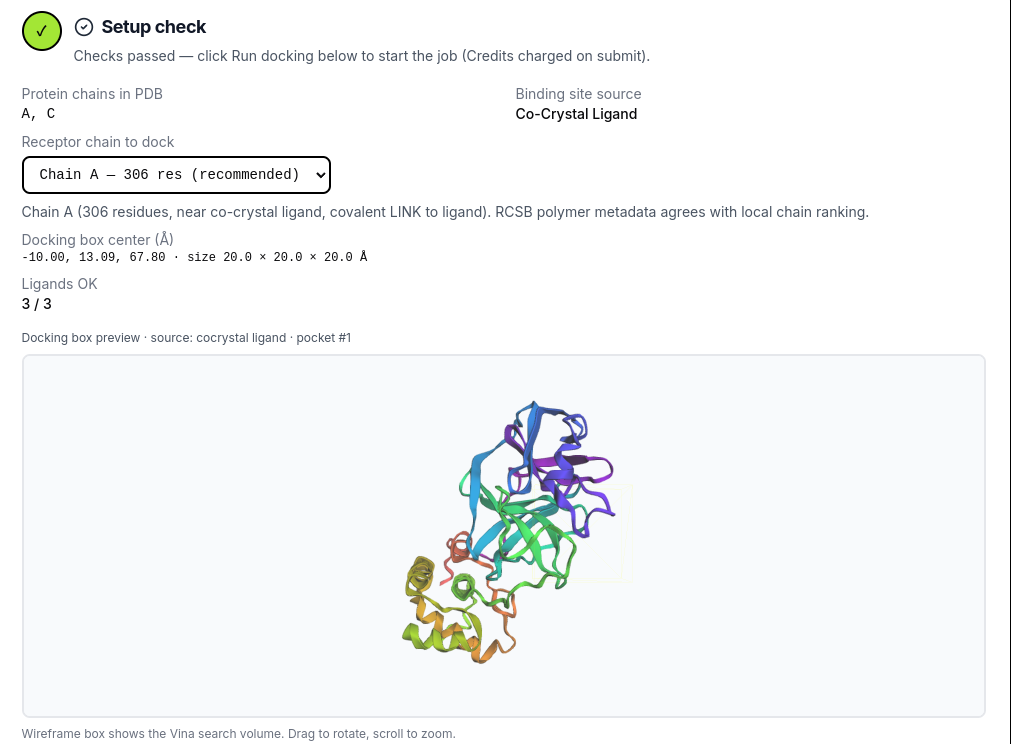
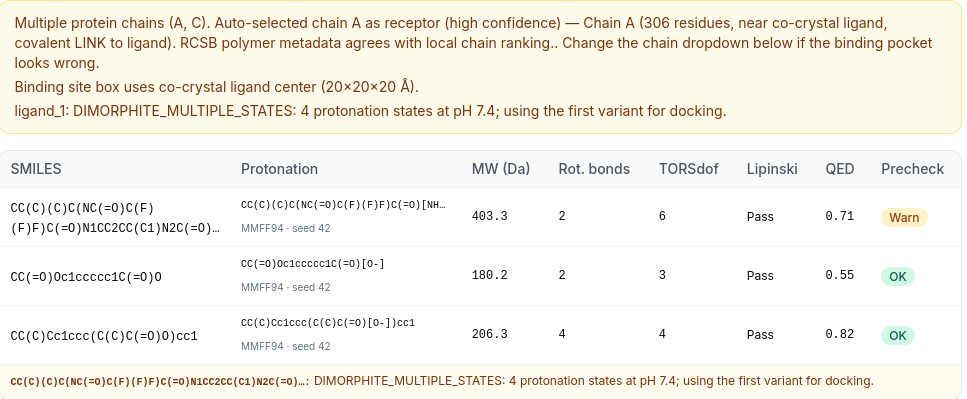
- Screening mode
- One receptor, 3 ligands (batch job)
- Receptor
- 6LU7 · SARS-CoV-2 main protease (Mpro)
- Chain(s)
- A
- Protonation pH
- 7.4
- Binding site
- cocrystal ligand
- Search box center (Å)
- -10.00, 13.09, 67.80
- Search box size (Å)
- 20.0 × 20.0 × 20.0
Reproducibility details, software versions, and manuscript-ready citations for reviewers.
Pipeline (v1.9.4): rigid-receptor AutoDock Vina docking with Meeko receptor/ligand preparation and RDKit 3D embedding.
Protonation: dimorphite-DL at pH 7.4. Protonation is applied before 3D embedding and minimization (MMFF94 with UFF fallback; multi-seed ETKDG).
Ligand prep: smiles → dimorphite_dl → ETKDG (multi-seed) → MMFF94/UFF → meeko_prepare_ligand
AutoDock Vina: exhaustiveness=8, num_modes=9, energy_range=3 kcal/mol, scoring=vina.
Open-source software stack
Exact versions recorded for this job — cite these in your Methods and reference list.
| Component | Version | Developer / org | Role | Ref. |
|---|---|---|---|---|
| AutoDock Vina | 1.2.7 | Scripps Research / community fork | Rigid-receptor molecular docking | [2] |
| Meeko | 0.7.1 | Scripps Research (Forli lab) | Receptor and ligand PDBQT preparation | [3] |
| RDKit | 2025.3.6 | Open-source cheminformatics toolkit | SMILES → 3D embedding (ETKDG) and MMFF94 minimization | [4] |
| PLIP | 3.0.0 | University of Hamburg (Salokas et al.) | Protein–ligand interaction profiling | [5] |
| PoseBusters | 0.6.5 | University of Oxford (Buttenschoen et al.) | Docking pose quality validation (dock configuration) | [6] |
| dimorphite-DL | 2.0.2 | Open-source protonation enumerator | Ligand protonation states at job pH | [7] |
| Biopython | 1.87 | Open-source bioinformatics library | Structure parsing and receptor handling | [8] |
| pocketeer | 0.3.1 | Apo binding-site prediction | Predicted pocket ranking for apo receptors | [9] |
| PyMOL (open-source) | not recorded | Schrödinger / community build | Optional publication-style binding-site render | [10] |
How to cite this tool in your paper
Paste the paragraph below into your Methods section; numbered references follow.
Suggested citation paragraph (Methods / Computational details)

Molecular docking was performed using the cloud-based workflow at MolecularDocking.online (pipeline v1.9.4)[1], utilizing AutoDock Vina 1.2.7[2] with Meeko receptor/ligand preparation (Meeko 0.7.1)[3]. The receptor structure was prepared from PDB 6LU7 (chain A). The search grid was centered at (-10.00, 13.09, 67.80) Å with dimensions 20.0 × 20.0 × 20.0 Å (source: cocrystal ligand). Ligands were built from SMILES using RDKit 2025.3.6 (ETKDG embedding, MMFF94 minimization)[4] with dimorphite-DL 2.0.2 protonation at pH 7.4[7]. AutoDock Vina was run with exhaustiveness=8, num_modes=9, and energy_range=3 kcal/mol; the top-ranked pose(s) per ligand were exported. Protein–ligand interactions were analyzed with PLIP 3.0.0[5]. Pose quality was validated with PoseBusters 0.6.5 (University of Oxford docking configuration)[6]. Computational binding scores and ADMET estimates are model predictions only; experimental validation is required.

References

[1] MolecularDocking.online. Cloud molecular docking workflow (https://molecular-docking.online). Accessed 2026.
[2] Eberhardt J, Santos-Martins D, Forli S, Olson AJ. AutoDock Vina 1.2.0: new docking methods, expanded force field, and Python bindings. J Chem Inf Model. 2021;61(8):3891-3898.
[3] Forli S, Huey R, Pique ME, Sanner MF, Olson AJ. Computational protein-ligand docking and virtual drug screening with the AutoDock suite. Nat Protoc. 2016;11(5):905-919.
[4] RDKit: Open-source cheminformatics. https://www.rdkit.org/ (accessed 2024).
[5] Salokas LM, Viswanath S, Aho AJ, et al. PLIP 2021: expanding the scope of the protein-ligand interaction profiler to DNA and RNA. Nucleic Acids Res. 2023;51(W1):W530-W534.
[6] Buttenschoen GF, Morris GM, Deane CM. PoseBusters: AI-based docking methods fail to generate physically valid poses or cause unintended bias. Nat Methods. 2024;21(3):472-480.
[7] Swain M. dimorphite-DL: an open-source program for enumerating the ionization states of drug-like small molecules. J Cheminform. 2019;11(1):14.
[8] Cock PA, Antao T, Chang JT, et al. Biopython: freely available Python tools for computational molecular biology and bioinformatics. Bioinformatics. 2009;25(11):1422-1423.
[9] pocketeer: apo binding-site prediction tool used for pocket ranking in this pipeline.
[10] Schrödinger LLC. The PyMOL Molecular Graphics System, Version 2.0. (Open-source build when enabled in Advanced options.)
Full reference list (10 entries)
- MolecularDocking.online. MolecularDocking.online. Cloud molecular docking workflow (https://molecular-docking.online). Accessed 2026.
- AutoDock Vina. Eberhardt J, Santos-Martins D, Forli S, Olson AJ. AutoDock Vina 1.2.0: new docking methods, expanded force field, and Python bindings. J Chem Inf Model. 2021;61(8):3891-3898.
- Meeko / AutoDock suite. Forli S, Huey R, Pique ME, Sanner MF, Olson AJ. Computational protein-ligand docking and virtual drug screening with the AutoDock suite. Nat Protoc. 2016;11(5):905-919.
- RDKit. RDKit: Open-source cheminformatics. https://www.rdkit.org/ (accessed 2024).
- PLIP. Salokas LM, Viswanath S, Aho AJ, et al. PLIP 2021: expanding the scope of the protein-ligand interaction profiler to DNA and RNA. Nucleic Acids Res. 2023;51(W1):W530-W534.
- PoseBusters. Buttenschoen GF, Morris GM, Deane CM. PoseBusters: AI-based docking methods fail to generate physically valid poses or cause unintended bias. Nat Methods. 2024;21(3):472-480.
- dimorphite-DL. Swain M. dimorphite-DL: an open-source program for enumerating the ionization states of drug-like small molecules. J Cheminform. 2019;11(1):14.
- Biopython. Cock PA, Antao T, Chang JT, et al. Biopython: freely available Python tools for computational molecular biology and bioinformatics. Bioinformatics. 2009;25(11):1422-1423.
- pocketeer. pocketeer: apo binding-site prediction tool used for pocket ranking in this pipeline.
- PyMOL. Schrödinger LLC. The PyMOL Molecular Graphics System, Version 2.0. (Open-source build when enabled in Advanced options.)
Discussion-style summary of predicted binding (similar to Fiverr manuscript support).
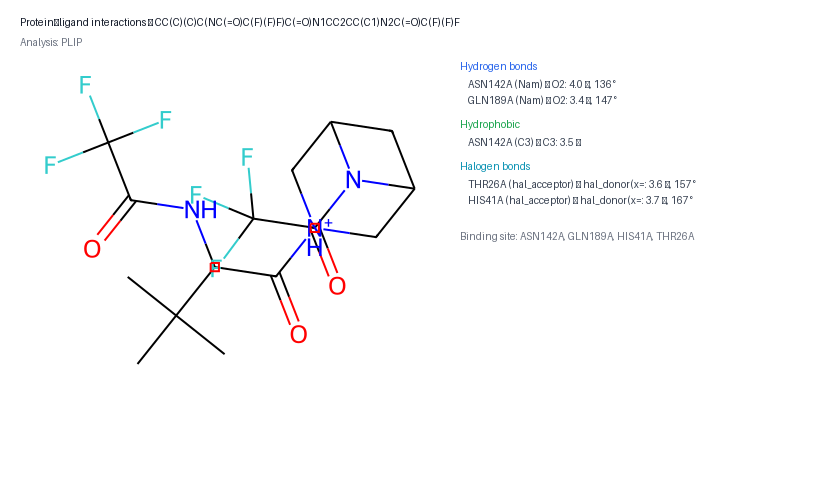
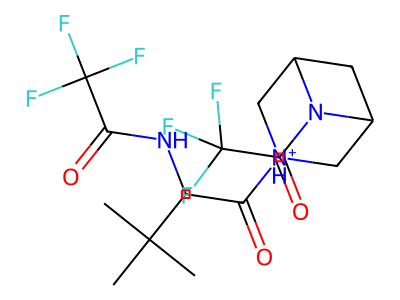
AutoDock Vina predicted moderate binding for CC(C)(C)C(NC(=O)C(F)(F)F)C(=O)N1CC2CC(C1)N2C(=O)C(F)(F)F (best score -6.21 kcal/mol). Among the screened compounds, CC(C)(C)C(NC(=O)C(F)(F)F)C(=O)N1CC2CC(C1)N2C(=O)C(F)(F)F ranked as the top hit. Key predicted interactions (PLIP) include 2 hydrogen bond(s) with ASN142A, GLN189A; hydrophobic contacts involving ASN142A; halogen bond(s) with HIS41A, THR26A. The ligand is surrounded by pocket residues including ASN142A, GLN189A, HIS41A, THR26A. Multiple docking modes have similar scores; consider inspecting alternate poses in the structure files. These results are computational predictions only and should be validated experimentally (e.g., SPR, ITC, or cell-based assays) before drawing mechanistic conclusions.
The best mode leads by 0.14 kcal/mol (<0.25 kcal/mol). The top pose is still the ranking winner, but alternate poses are close enough to review in the structure files.
PoseBusters: 22/22 checks passed.
Validated with PoseBusters (University of Oxford docking configuration).
Detected contacts (5 total)
PLIP- 2 hydrogen bond(s)
- 1 hydrophobic contact(s)
- 2 halogen bond(s)
Pocket residues: ASN142A, GLN189A, HIS41A, THR26A
Ready-to-use PNG images for slides and manuscripts (also included in the ZIP).
2D interaction diagram
LigPlot-style map of PLIP-detected hydrogen bonds, hydrophobic contacts, and salt bridges.
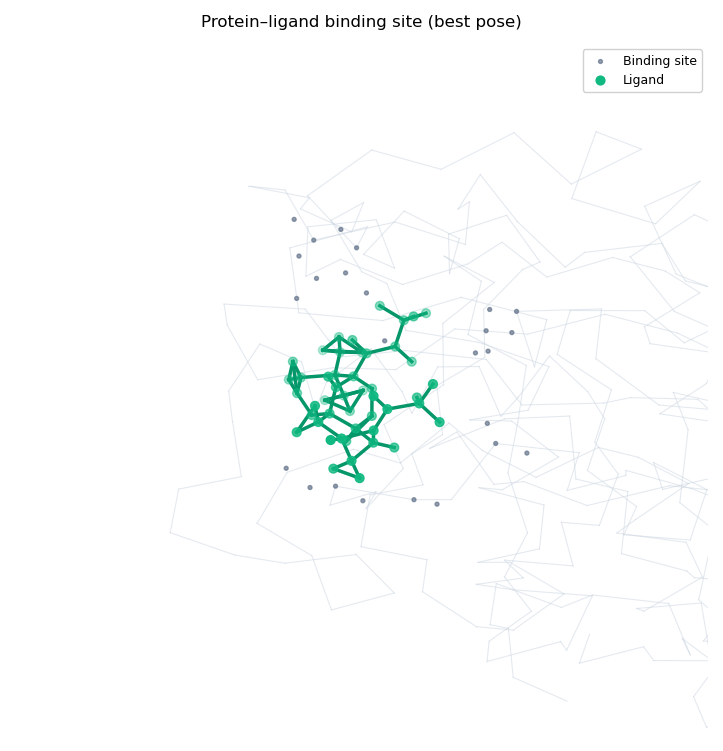
Binding-site overview
Highlighted pocket with docked ligand (matplotlib 3D overview).
2D ligand structure
Chemical structure of the protonated ligand used for docking.
PyMOL binding-site render
Ray-traced publication figure (cartoon receptor + sticks). Best hit only for batch jobs.
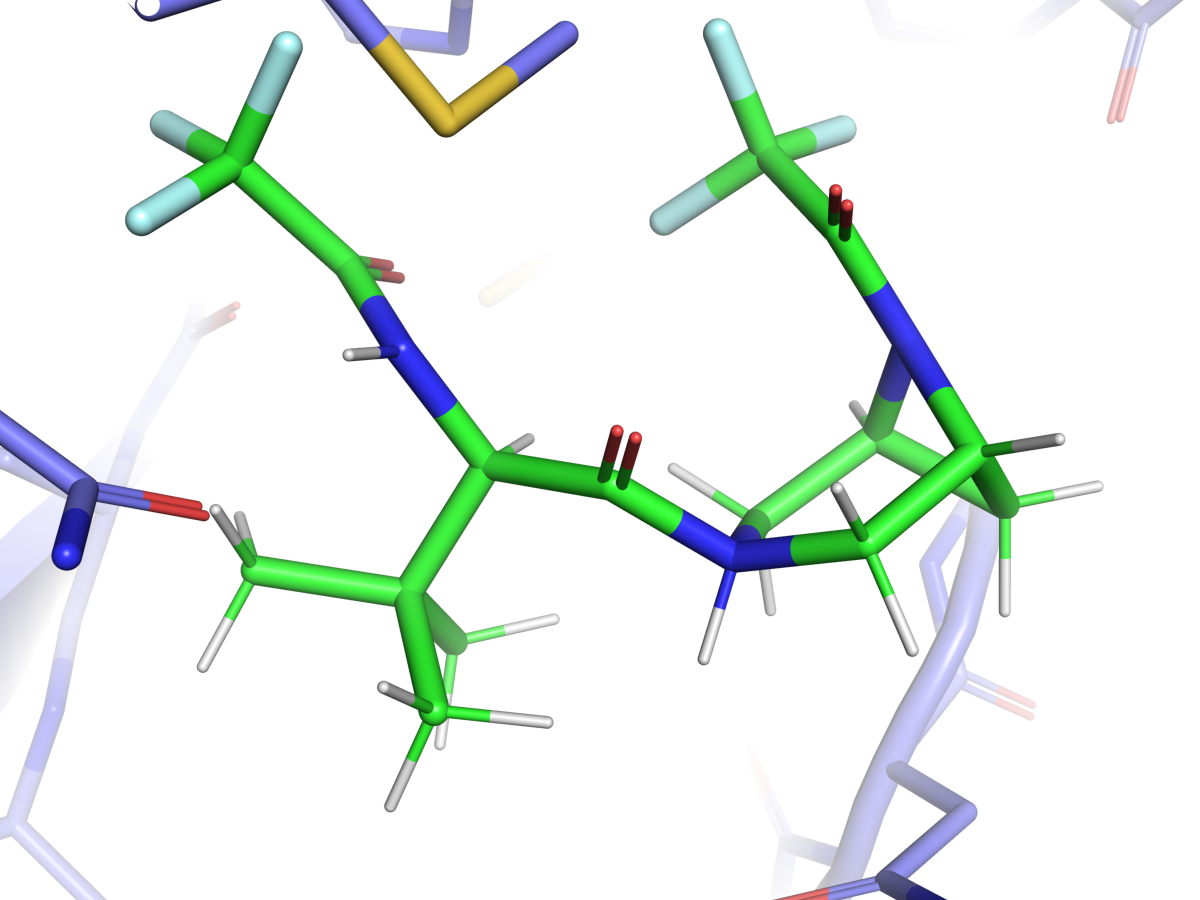
Interactive protein–ligand complex. Select ligand and Vina pose (top 3 exported). Pose 1 is the best-scoring mode.
Drag to rotate · scroll to zoom · right-drag to pan. Top 3 Vina poses are exported when available; pose 1 is the best-scoring mode.
RDKit-based drug-likeness estimates (Lipinski, Veber, QED). Not experimental ADMET.
- Molecular weight (Da)
- 404.3
- LogP
- 0.04
- TPSA (Ų)
- 70.9
- H-bond donors / H-bond acceptors
- 2 / 3
- Rotatable bonds
- 2
- QED
- 0.639
- Lipinski
- Pass
- Veber
- Pass
Computational ADMET estimates from RDKit descriptors; not experimental ADMET data.
Each row is one compound in this batch (3 total). Sorted by status, then affinity. ADMET columns included for screening comparison.
| # | Compound | SMILES | Status | Best affinity (kcal/mol) | Δ to 2nd | Pose confidence | Pose QC | MW (Da) | Lipinski | QED |
|---|---|---|---|---|---|---|---|---|---|---|
| 1 | Nirmatrelvir | CC(C)(C)C(NC(=O)C(F)(F)F)C(=O)N1CC2CC(C1)N2C(=O)… | OK | -6.21 | 0.14 | Close top poses | PoseBusters QC pass | 404.3 | Pass | 0.64 |
| 2 | Ibuprofen | CC(C)Cc1ccc(C(C)C(=O)O)cc1 | OK | -6.03 | 0.23 | Close top poses | PoseBusters QC pass | 205.3 | Pass | 0.75 |
| 3 | Aspirin | CC(=O)Oc1ccccc1C(=O)O | OK | -5.05 | 0.40 | Moderate separation | PoseBusters QC pass | 179.2 | Pass | 0.47 |
Receptor chain used: A
Binding site box uses co-crystal ligand center (20×20×20 Å).
ligand_1: DIMORPHITE_MULTIPLE_STATES: 4 protonation states at pH 7.4; using the first variant for docking.
ligand_1: Reused validated ligand PDBQT (protonation locked from Review setup).
ligand_2: Reused validated ligand PDBQT (protonation locked from Review setup).
ligand_3: Reused validated ligand PDBQT (protonation locked from Review setup).
- Rigid receptor only (no flexible side chains).
- One protein chain per job (select chain when PDB has multiple chains).
- Ligand protonation uses dimorphite_dl at job pH (default 7.4) or per-ligand ph override (4.0–10.0).
- Ligand input: SMILES, MOL block, or SDF (first record).
- Optional preserve_hetatm (e.g. ZN, MG) keeps metals in cleaned receptor PDB.
- Co-crystal redock sanity check runs when a bound ligand is detected (run_redock=true).
Ready to run your own docking job?
Start on the home page